


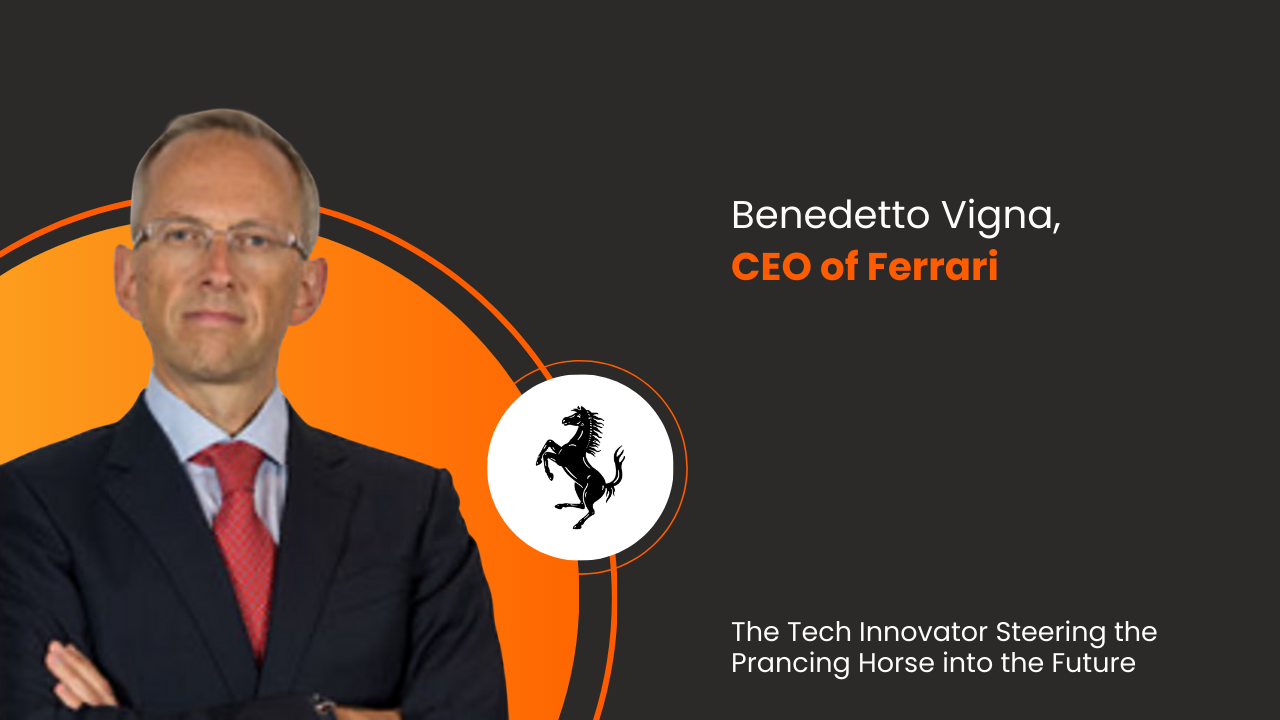
Benedetto Vigna, born in 1969 in southern Italy, is a physicist-turned-industry leader whose career bridges advanced science and iconic automotive innovation. After graduating cum laude in Physics from the University of Pisa and conducting research at leading European institutes, he joined STMicroelectronics, where he pioneered MEMS sensor technologies and led the company’s most profitable divisions. Appointed CEO of Ferrari in 2021, Vigna has been steering the brand through a historic transformation—balancing Ferrari’s legendary heritage with electrification, digital innovation, and future-ready manufacturing. Under his leadership, Ferrari is entering the electric era while preserving the emotion, performance, and exclusivity that define the brand.
Early Life & Education
Benedetto Vigna was born on April 10, 1969, in Potenza, located in the Basilicata region of southern Italy, and spent his early years in the nearby town of Pietrapertosa. He pursued a degree in Physics at the University of Pisa, graduating cum laude in sub-nuclear physics in 1993. Following his studies, Vigna engaged in scientific research at prestigious institutions such as the European Synchrotron Radiation Facility in Grenoble and the Max Planck Institute in Germany. These experiences built a strong scientific foundation before he transitioned into the technology industry.
Career Path – From Semiconductors to Supercars
In 1995, Vigna joined STMicroelectronics (ST), marking the start of a remarkable industrial career. Early on, he founded ST’s MEMS (Micro-Electro-Mechanical Systems) division, a pioneering move that would later revolutionize sensor technology in industries ranging from smartphones to automotive systems. Over the years, his scope of responsibility expanded significantly. He went on to lead ST’s Analog, MEMS & Sensors Group, which by 2020 had become the company’s largest and most profitable division. His leadership encompassed key domains such as connectivity, imaging, and power solutions, driving innovation across industrial and automotive markets.
Vigna’s contributions to science and technology are vast as he holds over 200 patents, has co-authored numerous publications, and has been actively involved in European research programs and global innovation boards related to sensors and microelectronics. However, his transition to Ferrari came with unique challenges. Moving from the semiconductor world into one of the world’s most emotionally charged luxury brands required adapting to a new culture steeped in heritage, passion, and performance. At Ferrari, he faced the task of guiding the company toward electrification and digital transformation while preserving its core identity.
Key Initiatives & Strategic Moves at Ferrari
Since taking over as CEO of Ferrari on September 1, 2021, Benedetto Vigna has led the company through a pivotal era of technological evolution. His focus has been clear: strengthen Ferrari’s innovation capabilities while ensuring its legacy remains untarnished.
| Year / Period | Initiative / Strategic Move | Significance |
|---|---|---|
| June 2021 | Ferrari announces Benedetto Vigna’s appointment as CEO, effective September 1, 2021. | Signaled Ferrari’s intent to embrace technological innovation and prepare for an electrified future. |
| 2021–2022 | Strengthened focus on hybrid-electric models, expanded in-car electronics, and increased R&D in electrification. | Set the foundation for Ferrari’s first fully electric model and long-term tech integration. |
| 2024 | Inauguration of Ferrari’s new “E-Building” in Maranello — designed to produce electric axles, batteries, and support hybrid and ICE cars under one roof. | Demonstrates Ferrari’s manufacturing flexibility and readiness for EV production. |
| 2025 (Planned) | Launch of Ferrari’s first fully electric supercar by end of 2025; production expected to begin in early 2026 at the E-Building. | Marks Ferrari’s historic transition into the era of fully electric high-performance vehicles. |
Achievements Under Vigna’s Leadership
Accelerated Electrification: Commitment to launch Ferrari’s first fully electric model by 2025, signaling a major step in its evolution.
Strategic Investments: Development of the €200 million E-Building in Maranello — a state-of-the-art facility allowing simultaneous production of ICE, hybrid, and EV models.
Innovation Surge: Ferrari filed 181 patent applications in Italy in 2023, reflecting a strong rise in R&D activity.
Global Recognition: Vigna’s prior contributions at STMicroelectronics, including advancements in MEMS sensors and motion detection technologies, established him as a pioneer in applied physics and engineering innovation.
Cultural Transformation: He has driven a mindset shift within Ferrari, emphasizing agility, experimentation, and collaboration, encapsulated by his “try, fail, learn” philosophy.
Accelerated Electrification: Commitment to launch Ferrari’s first fully electric model by 2025, signaling a major step in its evolution.
Strategic Investments: Development of the €200 million E-Building in Maranello — a state-of-the-art facility allowing simultaneous production of ICE, hybrid, and EV models.
Innovation Surge: Ferrari filed 181 patent applications in Italy in 2023, reflecting a strong rise in R&D activity.
Global Recognition: Vigna’s prior contributions at STMicroelectronics, including advancements in MEMS sensors and motion detection technologies, established him as a pioneer in applied physics and engineering innovation.
Cultural Transformation: He has driven a mindset shift within Ferrari, emphasizing agility, experimentation, and collaboration, encapsulated by his “try, fail, learn” philosophy.
Challenges & Transformation Journey
Leading Ferrari into the electric age is no small feat. Vigna’s journey has been marked by complex challenges:
Preserving Ferrari’s Heritage: Ferrari’s identity is deeply tied to its signature V12 engines and emotional driving experience. Convincing traditionalists that electric Ferraris can deliver the same passion is a delicate challenge.
Balancing Costs and Returns: Building EV capability, from battery technology to production infrastructure, demands significant capital investment, all while maintaining Ferrari’s exclusivity and profit margins.
Navigating Market Uncertainty: Regulatory changes, fluctuating demand for EVs, and global supply chain constraints add unpredictability to the transition.
Cultural Shift: Bringing a tech-driven mindset into a company long defined by craftsmanship and tradition requires rethinking processes, re-training teams, and forming new partnerships.






 WhatsApp
 LinkedIn
 Facebook
 X
X
 Email
Email