Europe’s data center market is expanding rapidly, driven by AI, cloud computing, digital transformation, and data sovereignty requirements. This growth is creating strong opportunities for the AEC industry, particularly in data center design, MEP engineering, power and grid integration, cooling systems, BIM, construction management, commissioning, and sustainability services. Key growth markets include France, Germany, the UK, Spain, Portugal, Italy, Ireland, and the Nordic countries, with power availability and grid connectivity increasingly determining where new data centers are developed.
| Metric |
Latest indication |
Definition and interpretation |
| Total European installed IT power |
14,784 MW, end-2025 |
Enterprise, colocation and hyperscale facilities of 50 kW or more.
EUDCA/Pb7 estimate. This is installed IT power, not construction
value or utility input power. |
| European colocation IT power |
10,392 MW in 2026; 20,892 MW in 2030 |
Forecast installed customer-facing colocation capacity. Scale
colocation is the fastest-growing component; forecast risk rises
in later years. |
| FLAP-D live capacity |
Approximately 3.8 GW, H1 2026 |
Metro-market live capacity. A further 1.4 GW was under construction
and 2 GW planned; vacancy was 6.4% in Q2 2026. |
| EMEA operational capacity |
12.1 GW, H1 2026 |
Cushman & Wakefield’s wider EMEA geography is not directly
comparable with Europe-only EUDCA figures. Its committed pipeline
was 18.3 GW: 3.8 GW under construction and 14.5 GW planned. |
| Modelled AEC investment |
€176 billion, 2026–2031 |
EUDCA/Pb7 construction and installation investment model, driven
principally by scale-colocation development. It excludes much
tenant IT hardware expenditure. |
| Commercial construction-market estimate |
US$11.6 billion in 2024 to US$32.27 billion in 2030 |
Arizton estimate covering electrical, mechanical, core-and-shell,
design, commissioning and associated construction categories;
CAGR 18.58%. |
| European electricity footprint |
57.9 TWh in 2024 |
EUDCA/Pb7 estimate for EU-27 enterprise, colocation and hyperscale
facilities; about 2.1% of EU electricity consumption in its model. |
| Global demand context |
415 TWh to 945 TWh by 2030 |
IEA-derived global, not European, data-centre electricity forecast
cited by the European Commission. Accelerated computing and AI are
the principal drivers. |
Demand drivers are mutually reinforcing: cloud migration,
AI training and inference, enterprise consolidation into colocation,
European digital sovereignty, streaming and connected services, and highly
regulated workloads requiring local or sovereign hosting. The January 2026
launch of the AWS European Sovereign Cloud in Germany, followed by planned
local zones in Belgium, the Netherlands and Portugal, demonstrates that
sovereignty is becoming a physical-infrastructure demand driver rather than
merely a software positioning theme.
2. Geographic Market Map
| Market cluster |
Capacity and momentum |
AEC attraction |
Principal constraint |
| Frankfurt / Germany |
EUDCA forecasts metro colocation from
1,273 MW in 2026 to 2,376 MW in 2030. |
Deep cloud and interconnection ecosystem; second-ring development;
heat-network, monitoring and retrofit demand.
|
Long connection times, scarce metro land and EnEfG requirements
for efficiency, management systems and waste-heat use for new
centres from July 2026. |
| London / UK |
Forecast 1,333 MW to 1,885 MW in 2026–2030;
Europe’s largest established metro base in the EUDCA series. |
Core London capacity plus regional clusters in South Wales, North
Wales, Oxfordshire, the North East and Scotland.
|
Grid queues, high land costs and planning complexity. UK AI Growth
Zones seek to accelerate power and planning and enable
developer-built HV infrastructure. |
| Paris / wider France |
Paris forecast 670 MW to 1,013 MW; France has about
300 data centres and an estimated 10 TWh annual consumption. |
Low-carbon electricity, industrial brownfields, Paris-Saclay and
Hauts-de-France “AI Valley”; five very-high-power fast-track sites.
|
Large grid queue, local acceptance and conversion of announced
investments into energised phases.
|
| Amsterdam / Netherlands |
Forecast 778 MW to 1,336 MW; H1 2026 deliveries
were 16.3 MW. |
Interconnection-rich operational market; retrofit, energy
optimisation and regional spillover.
|
Structural grid congestion, restrictive city policy and waits that
the Dutch industry says can reach 5–10+ years. |
| Dublin / Ireland |
Forecast 478 MW to 758 MW through 2030. |
Established hyperscale ecosystem; opportunities in regional sites,
microgrids, storage and renewable integration.
|
Data centres used 22% of Irish electricity in 2024. New connections
require matching generation or storage and at least 80% additional
Irish renewable electricity, with locational grid assessment. |
| Milan / Northern Italy |
Forecast 388 MW to 1,016 MW; one of Europe’s
fastest-maturing Tier-2 metros. |
Available development sites, national strategic-project
recognition, carrier links to central Europe and active operator
pipelines.
|
Growing demand for grid capacity, specialised supply chain and
permitting certainty. |
| Spain and Portugal |
Southern Europe forecast
1,475 MW in 2026 to 4,990 MW in 2030; Spain, Italy
and Portugal drive most of the increase. |
Renewable potential, land, subsea connectivity,
Madrid–Aragón–Barcelona and Lisbon–Sines corridors, and large AI
campuses.
|
Spain’s August 2026 draft rules propose additional-renewable,
hourly matching, water-efficiency and sovereignty conditions;
final rules remained uncertain at the research cut-off. |
| Nordics |
Forecast 1,287 MW to 3,663 MW in 2026–2030;
Helsinki joined the major EMEA “powerhouse” group in 2026. |
Renewable power, cooler climate, large sites, district heating and
AI-training campuses.
|
Remote-campus connectivity, local labour depth, transmission
delivery and community or environmental commitments. Heat reuse is
increasingly part of the site proposition. |
| CEE / Warsaw–Vienna corridor |
Regional colocation forecast
883 MW to 1,401 MW; Warsaw
188 MW to 301 MW. |
Sovereign and regional workload growth, lower land costs and
resilience diversification.
|
Smaller ecosystems, variable power carbon intensity,
specialist-contractor depth and country-specific permitting. |
Market interpretation: Retain FLAP-D for latency-sensitive
cloud, finance, interconnection and AI inference; pursue France, Iberia and
the Nordics for large AI training or HPC campuses; and treat Milan, Warsaw,
Vienna, Brussels and regional UK markets as selective expansion plays.
This is a portfolio strategy, not a wholesale migration from established
hubs.
3. Representative Development Pipeline
| Project |
Publicly Disclosed Scale |
Status at Cut-off |
AEC Implications |
|
SINES Data Campus, Portugal — Start Campus
|
1.2 GW; €8.5 billion construction investment
|
SIN01, with 26 MW, is operational. The six-building campus has
secured grid access. SIN02 was announced as a 180 MW next phase.
|
Seawater cooling, liquid-cooling readiness, subsea connectivity,
high-voltage systems and phased megacampus delivery.
|
|
Escaudain, France — Data4
|
700 MW; €5 billion; 33 ha; four facilities
|
Launched in June 2026 on a former industrial site.
|
Brownfield remediation, low-carbon concrete, heat recovery,
workforce development and new utility infrastructure.
|
|
Strängnäs, Sweden — Brookfield
|
Expansion from 300 MW to 750 MW; up to SEK 95 billion
|
Land-allocation-led programme announced in June 2025, with a
10–15-year construction horizon.
|
Long-term campus master planning, grid and energy integration,
local supply-chain development and multi-phase commissioning.
|
|
Muhos, Finland — Google
|
Part of a
€13 billion Finland data-centre and supporting-infrastructure plan;
site MW undisclosed.
|
Site preparation was underway in 2026, and the project remained
in development. |
Circularity, waste-heat reuse, enabling works, permitting and
supplier qualification. The €13 billion figure applies across
Finland and is not specific to Muhos.
|
|
Extremadura, Spain — MERLIN Edged
|
Two proposed campuses of approximately 1 GW each
|
Navalmoral was positioned as ready to build. Valdecaballeros
requires additional infrastructure and planning work.
|
400 kV connections, roads, fibre, waterless cooling,
multi-building standardisation and major upfront planning scope.
|
|
MXP2 Milan — Vantage
|
32 MW; more than €350 million; two buildings
|
The first phase was scheduled for spring 2026. The cited
announcement does not independently confirm final operational
handover.
|
HV substations, closed-loop cooling, stormwater management,
nature-based landscape design and integration with an existing
operator platform.
|
|
Brandenburg — AWS European Sovereign Cloud
|
€7.8 billion through 2040
|
The Sovereign Cloud became generally available in January 2026,
with subsequent expansion across the European Union planned.
|
Security-led design, operational separation, regulatory compliance
and repeatable sovereign local-zone infrastructure.
|
|
France AI Infrastructure — Brookfield
|
€10 billion AI factory; 1 GW within a wider
€20 billion programme.
|
Announced in 2025. Delivery phasing and site-level AEC awards were
not disclosed in the reviewed source.
|
A major future opportunity, but currently a programme-level lead
that requires qualification before it can be treated as
executable backlog.
|
4. Major Ecosystem Participants
Operators and developers: Equinix, Digital Realty,
NTT Global Data Centers, Vantage, CyrusOne, STACK Infrastructure,
Colt DCS, Data4, Start Campus, atNorth, Green Mountain and MERLIN Edged
are representative pan-European or regional platforms.
AWS, Microsoft, Google and Meta influence both self-build and wholesale
demand. AI-cloud firms such as CoreWeave and Nscale are opening another
high-density client category. This is an ecosystem map and not a
market-share ranking.
AEC and delivery participants: Engineering and design
companies evidenced in sector research include Arup, AECOM, Artelia,
AtkinsRéalis, Ramboll, COWI, Deerns, RED Engineering and
Royal HaskoningDHV.
Programme and cost specialists include Turner & Townsend, Linesight,
Mace and RLB. Construction and MEP delivery firms include Mercury,
Winthrop Technologies, Exyte, Bouygues, Collen, John Sisk & Son,
Kirby and DPR.
OEM relationships commonly involve Schneider Electric, Siemens Energy,
Vertiv, ABB, Eaton and Legrand. Arup spans site due diligence,
master planning, architecture, engineering, retrofit and reference
design. Turner & Townsend focuses on programme, cost, procurement
and commissioning control.
Integrated European delivery: Mercury and Winthrop
illustrate the shift towards integrated delivery partners. Mercury
reports more than 200 European data-centre projects and investment in
a German off-site manufacturing facility.
Winthrop offers tu
rnkey CSA, MEP and commissioning services and publicly
lists current projects across Italy, Finland, Amsterdam, Dublin and
Frankfurt.
5. AEC Opportunity Chain
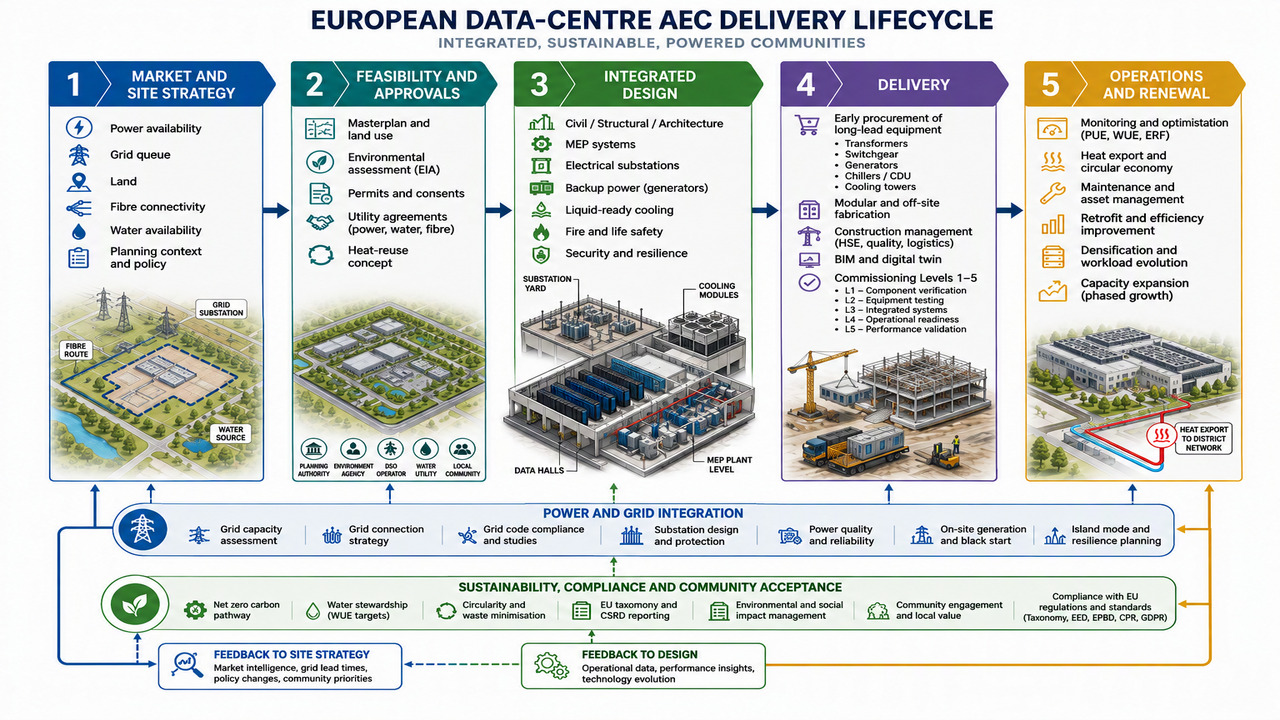
The following diagram shows where AEC firms can enter the value chain.
Evidence from Arup, Turner & Townsend and current market surveys
indicates that grid, permitting and procurement decisions increasingly
precede, and often determine, the conventional building-design scope.

Figure 1: The AEC opportunity spans the full data-centre lifecycle: power-secured site strategy and permitting lead into integrated design, procurement, construction and commissioning, with operations generating retrofit and expansion work.
Highest-value service areas
Powered-site strategy: grid-capacity screening, substation concept, fibre diversity, land and environmental diligence, flood/climate resilience and realistic power dates.
Planning and stakeholder advisory: EIA, noise, visual impact, biodiversity, water strategy, heat-reuse feasibility and evidence-based community-benefit plans.
AI-ready integrated design: high-capacity electrical architecture, liquid-ready cooling, structural loading, maintainability, fire/life safety, security and flexible data-hall layouts.
Energy integration: HV substations, BESS/microgrids, PPAs, on-site generation, flexible-load studies and district-heating interfaces.
Programme and procurement: local-code adaptation of global reference designs, transformer/switchgear/chiller procurement, contractor packaging, cost control and schedule-risk management.
Digital delivery: BIM coordination, digital twins, prefabricated MEP/plant modules, asset information and operational telemetry.
Commissioning and retrofit: integrated systems testing, live-site work, density upgrades, liquid-cooling conversion, PUE/WUE improvement and legacy-facility expansion.
These opportunities are evidence-backed: AI facilities are producing higher thermal loads and accelerating liquid/hybrid cooling, while reference designs and off-site fabrication are being used to improve repeatability and delivery certainty. The market still needs air and hybrid systems, so “liquid-ready and workload-specific” is more credible than claiming universal liquid-cooling conversion.
6. Principal risks through 2030
Grid and pipeline credibility: connection queues contain speculative and duplicate applications. Qualification should distinguish a request, reserved capacity, connection offer, energisation date and delivered load.
Regulatory divergence: EU reporting is becoming standardised under the Energy Efficiency Directive and Regulation EU/2024/1364, while the Commission proposed a common rating system in September 2026 and is considering minimum performance standards. Germany, Ireland and Spain layer additional national requirements on top.
Water and heat-reuse viability: water stress strengthens the case for closed-loop or low-water systems, but heat reuse depends on an accessible off-taker, temperature, network proximity and commercial allocation of heat-pump costs.
Labour and supply chain: electricians, HVAC/MEP specialists, commissioning staff, transformers, switchgear and cooling equipment remain schedule-sensitive. Modularisation mitigates—but does not eliminate—design freeze, logistics and supplier-capacity risk.
Community acceptance: projects can encounter resistance over power, water, noise, land take, visual massing and perceived low permanent employment. Early landscape, biodiversity, heat, skills and tax-benefit commitments increasingly support consentability.
7. Actionable AEC/marketing takeways evidence-backed priorites
Lead with “power-to-permit certainty,” not generic BIM or drafting. The commercial problem is converting land and announced MW into consented, connected, commissionable capacity.
Target buying groups beyond conventional design directors: operator development teams, hyperscaler site-acquisition teams, infrastructure funds, utilities, renewable developers, programme managers, general contractors and cooling/power OEM partners.
Watch project triggers: land allocation, substation agreement, grid offer, planning filing, PPA, AI tenant/lease, government strategic designation, contractor prequalification and long-lead equipment order.
Recommended BD packaging — judgment
Powered Site Readiness Sprint: grid, land, fibre, water, planning and carbon risk screen.
AI-Ready Design Adaptation: convert a client’s reference design for local code, liquid-ready cooling and phased density.
Permit & Community Evidence Pack: environmental, heat-reuse, biodiversity, noise and local-benefit narrative.
Digital Delivery Factory: BIM coordination, design production, quantity verification, modularisation and information management.
Commissioning Readiness / Retrofit: commissioning documentation, capacity audits and legacy densification.









 WhatsApp
 LinkedIn
 Facebook
 X
 Email