

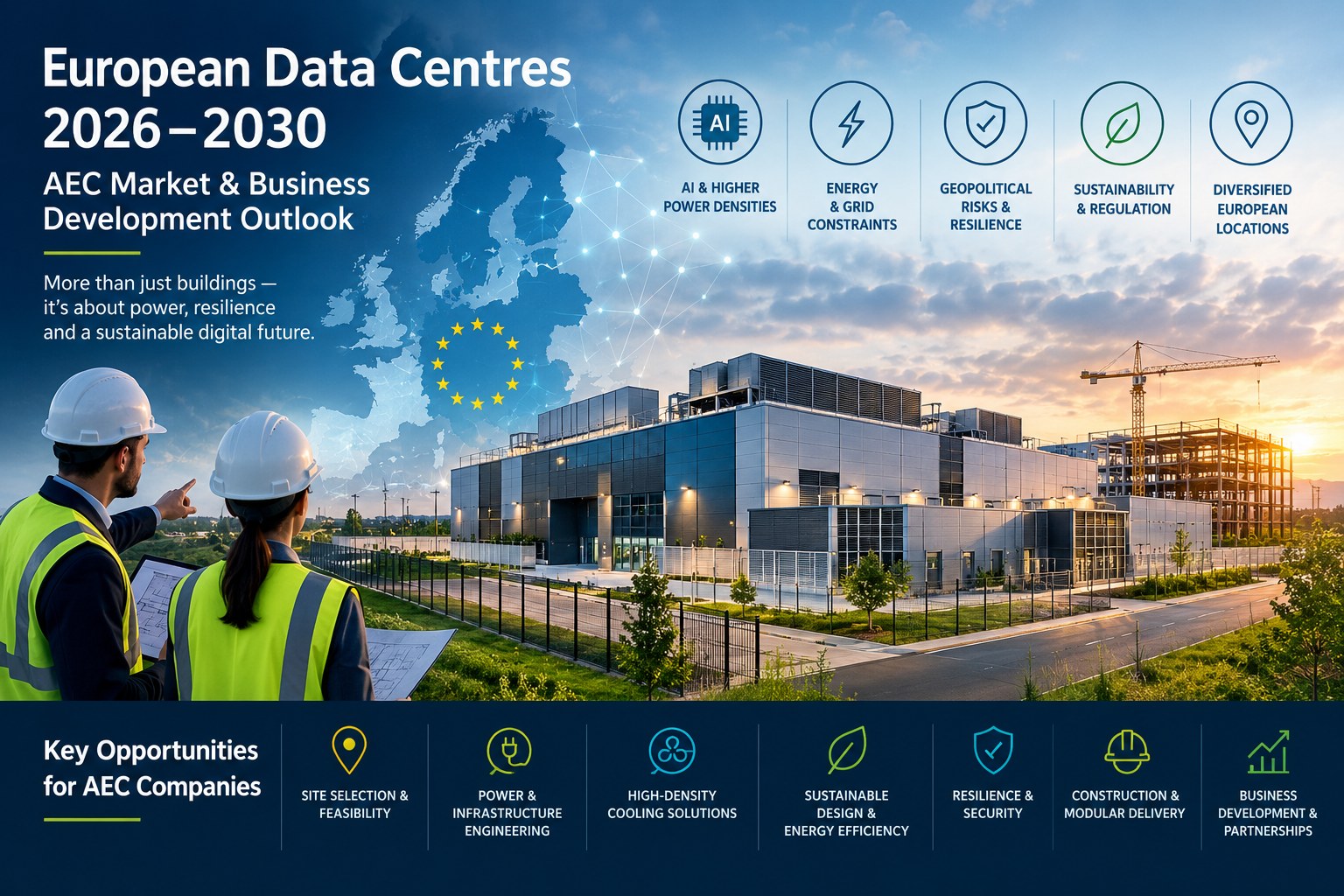
Europe’s data centre market is evolving rapidly as AI growth, energy constraints, sustainability requirements and geopolitical uncertainty reshape infrastructure planning. This blog explores the key market trends shaping European data centres from 2026 to 2030 and highlights emerging opportunities for AEC companies in engineering, construction, infrastructure, resilience and business development.
How Geopolitics, Energy, AI and Infrastructure Are Changing the European Data Centre Market
Europe's data centre market is entering an important period
of growth, but the market is also becoming more complicated.
The demand for data centre capacity is increasing because of
cloud computing, AI, digital services and the growing need for local data
infrastructure. At the same time, developers are dealing with power shortages,
grid constraints, higher construction requirements, sustainability regulations
and geopolitical uncertainty.
The Russia–Ukraine war has added another consideration: infrastructure
resilience and security.
For Architecture, Engineering and Construction (AEC) companies, these changes are creating new opportunities. However, the way companies approach the market needs to change as well.
Geopolitics is becoming part of data centre planning
Data centres are critical infrastructure. They depend on
electricity, telecommunications, fibre networks, cooling systems and other
supporting infrastructure.
The war in Ukraine has highlighted how important the
resilience of critical infrastructure can be. Across Europe, governments and
businesses are paying greater attention to the protection and continuity of
essential infrastructure.
For data centre developers, this means that factors such as
backup power, multiple fibre routes, redundant infrastructure, physical
security and disaster recovery are becoming increasingly important.
For AEC companies, these requirements create opportunities
beyond traditional building design and construction.
Engineering teams may increasingly be involved in designing:
- Redundant
power infrastructure
- Backup
and emergency systems
- Secure
utility connections
- Multiple
fibre routes
- Physical
security systems
- Resilient
cooling infrastructure
- Disaster
recovery facilities
- Infrastructure
designed for business continuity
The exact requirements will vary by country and
project, but resilience is becoming an important part of the overall design
discussion.
Power availability could become the biggest constraint
There is an interesting change taking place in the European
data centre market.
Demand is strong, but finding suitable power capacity is
becoming increasingly difficult.
A data centre may have suitable land and strong customer
demand, but without sufficient electricity and a realistic grid connection
timeline, the project cannot move forward.
This is changing how developers evaluate potential
locations.
Previously, proximity to major business centres was often a
major consideration. Today, developers also need to look at:
Power + Land + Fibre + Renewable Energy + Water +
Planning + Security + Workforce
This creates an opportunity for AEC companies to become
involved much earlier in the development process.
Instead of entering the project only after the site has been
selected, AEC firms can support developers during site evaluation, feasibility
studies, infrastructure planning and early-stage engineering.
AI is changing the data centre itself
Artificial intelligence is another major factor shaping the
market between 2026 and 2030.
AI workloads require significant computing power. As
organisations deploy more AI applications, demand for high-density computing
infrastructure is increasing.
That has a direct impact on data centre design.
Traditional approaches to power distribution and cooling may
not be sufficient for every new AI-focused facility. Developers and engineering
companies are looking more closely at high-density electrical systems, liquid
cooling, thermal management and efficient power distribution.
This creates opportunities for AEC companies with expertise
in:
- Electrical
engineering
- MEP
design
- High-density
cooling
- Liquid
cooling
- HVAC
- Fire
protection
- Structural
engineering
- Modular
construction
- Energy
management
- Data centre retrofits and upgrades
AI therefore represents not only a technology opportunity
but also a physical infrastructure opportunity.
Europe is also becoming more focused on energy efficiency
Sustainability has been an important topic for data centres
for several years. The focus is now becoming more practical.
Energy consumption, water usage, renewable energy and waste
heat are increasingly part of the planning conversation.
European regulations are also pushing data centre operators
towards greater transparency around energy and environmental performance.
For AEC companies, this means sustainability cannot simply
be treated as an additional feature at the end of a project.
It needs to be considered during the initial design stage.
This could include:
- Energy-efficient
building design
- Renewable-energy
integration
- Efficient
cooling systems
- Water-efficient
cooling
- Waste-heat
recovery
- Energy
monitoring
- Battery
storage
- Grid
flexibility
- Low-carbon
construction approaches
These requirements can also create opportunities for
specialist engineering and consulting services.
Will the market move beyond the traditional data centre
hubs?
Frankfurt, London, Amsterdam, Paris and Dublin have
historically been important European data centre markets.
However, these established locations face challenges
including grid capacity, land availability, planning requirements and
increasing development costs.
As a result, developers are looking at additional European
locations.
This does not mean that the established markets will become
less important. Instead, the market may become more geographically diversified.
For AEC companies, this is an important area to monitor.
Emerging locations should be evaluated not simply on
construction cost, but on the complete infrastructure picture:
Can the site get enough power?
Is there reliable fibre connectivity?
Is suitable land available?
Can the project obtain planning approval?
Is renewable energy available?
Are water resources sufficient for the proposed cooling
technology?
Is the location suitable from a security and resilience
perspective?
These questions can become part of an AEC company's
business-development proposition.
What does this mean for AEC business development?
The European data centre opportunity is not limited to
companies that physically construct data centres.
There is a much larger ecosystem around each project.
Potential customers and partners include:
- Data
centre operators
- Hyperscalers
- Cloud
service providers
- AI
infrastructure companies
- Real
estate developers
- Infrastructure
investors
- Private
equity firms
- Utilities
- EPC
contractors
- Engineering
consultants
- Technology
providers
- Government
and infrastructure agencies
For an AEC company, identifying these organisations early
can make a significant difference.
Instead of running a broad campaign saying "We provide engineering services," companies can develop more specific
propositions around the problems data centre developers are trying to solve.
For example:
- Data Centre Site Feasibility
- AI Data Centre Engineering
- Data Centre Power & Electrical Engineering
- High-Density Cooling Solutions
- Data Centre Expansion & Retrofit
- Critical Infrastructure Resilience
- Sustainable Data Centre Design
- Modular Data Centre Construction
These propositions are easier to connect with specific
market requirements.
A more focused European BD strategy
A practical business-development approach could start with
the market and work down to the individual project.
Europe → Country → Data Centre Market → Developer →
Project → Decision Maker → AEC Requirement
For example, instead of targeting every company in Germany,
an AEC business-development team could identify data centre developments in a
particular region, understand who owns or develops them, identify the
engineering and construction requirements, and then map the relevant
decision-makers.
This creates a much more focused account-based marketing
approach.
It also allows marketing and sales teams to build content
around actual market requirements rather than generic service promotion.
What should AEC companies watch between 2026 and 2030?
Several areas are likely to remain important:
|
Market factor |
Potential AEC impact |
|
Grid capacity |
Can determine whether a project can proceed |
|
AI growth |
Creates demand for high-density infrastructure |
|
Renewable energy |
Influences site selection and sustainability planning |
|
Planning regulations |
Can affect project timelines |
|
Water availability |
Influences cooling-system choices |
|
Fibre connectivity |
Important for cloud and AI infrastructure |
|
Geopolitical risk |
Increases focus on resilience and security |
|
Construction capacity |
Can affect delivery schedules and costs |
|
Land availability |
Encourages development in new locations |
|
Energy efficiency |
Increasingly important for design and operations |
Looking ahead to 2030
The European data centre market is likely to look different
by the end of this decade.
The biggest projects may increasingly be shaped by the
availability of power, the growth of AI, renewable-energy access and the need
for resilient infrastructure.
For AEC companies, this means there is an opportunity to
move closer to the beginning of the project lifecycle.
Rather than waiting for a developer to issue a construction
or engineering requirement, companies can engage earlier around site
feasibility, infrastructure planning, energy, resilience, sustainability and
project development.
That requires a different approach to business development.
The conversation should not simply be about "Can we
build your data centre?"
It should also be about:
Where should you build it?
Can the site support the required power?
How can the infrastructure be designed for future AI
workloads?
How can the facility become more energy efficient?
How can the project be designed for greater resilience?
These are the types of questions that are likely to shape
European data centre development through 2030.
Final thoughts
The European data centre market is being influenced by
several forces at the same time: AI, cloud growth, energy requirements,
regulation, sustainability and geopolitical uncertainty.
For the AEC industry, this creates a market where technical
expertise and early involvement can become increasingly valuable.
Companies that understand the wider data centre
ecosystem—and build their business-development strategy around specific
projects, locations and infrastructure requirements—will have more
opportunities to participate in this growing market.
The opportunity is not simply in constructing more data
centres. It is in helping developers find the right location, solve
infrastructure challenges and build facilities that can support Europe's
digital requirements for the next decade.




 WhatsApp
 LinkedIn
 Facebook
 X
X
 Email
Email