Explore PrognoCIS EMR Features & Capabilities.
Patient Charting
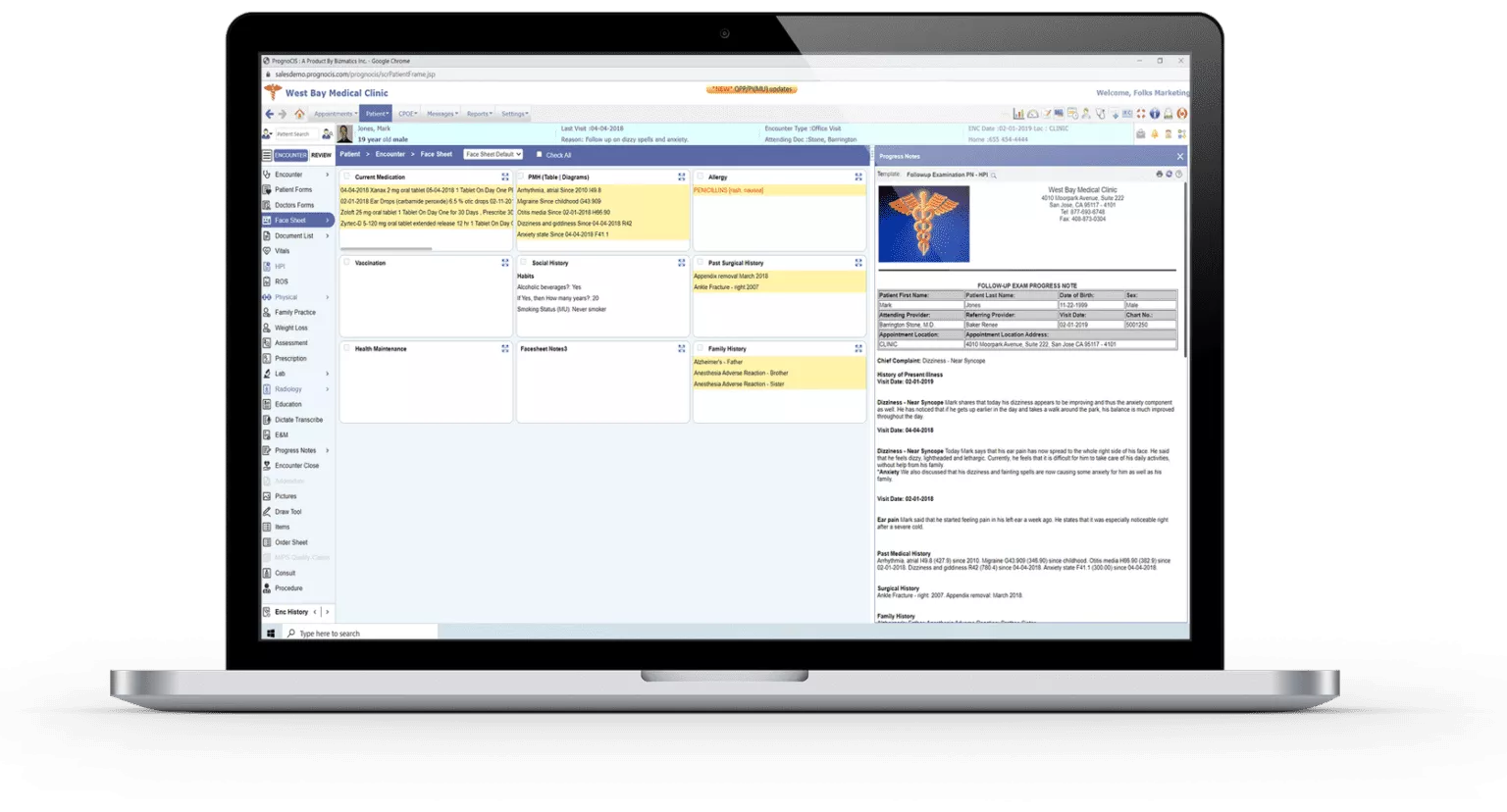
Easy to use templates
Automated workflows
Customizable Smart Phrases to speed up documentation
Specialty templates specific to the needs of your practice
Dozens of Progress Note styles to choose or create your own
Easily share documents with patients and provider.
EPCS
Secure method for sending control substances
Prevents counterfeit prescriptions
Increasing e-prescribing rates to assist in meeting CMS monitoring requirements
Reduce errors in prescribing
Electronic Prior Authorization.
Patient Relations
Customize schedule
Send appointment reminders
Use patient portal
Online patient payments
Custom Medical Forms
Staff Accounts
Superbill.
Increase Productivity with EHR Software
Mature product with 18+ years of Electronic Medical Record performance
Interoperable with your eRx (e-prescription), PACs and lab connectivity
Your choice of cloud-based and local server-based
Real-Time Prescription Benefit feature
Time-proven implementation methods for a successful EHR transition.
Key Features of PrognoCIS EHR System
Looking for the most suitable electronic health record (EHR) system to incorporate within a healthcare practice can be a detailed process. At times, electronic medical records software can be time-consuming because of the lengthy workflow.
The solution lies in looking for a customizable EHR solution, which empowers healthcare practitioners to deliver services proficiently.
A certified EMR system is the most appropriate solution for enhancing the workflow and overall resourcefulness of a healthcare practice.
The ultimate effect of developing a customized EHR platform is not just the benefits it has for healthcare providers and their staff, but also the positive impact it has on the patients and healthcare professionals, pharmacists and, lab technicians.
Clinical Documentation
The inflexibility of standard Electronic Health Records templates often restrains healthcare professionals from obtaining accurate patient health information, whereas a customized EHR template integrates patients’ data to collect valuable clinical data.
Why Electronic Medical Record Template Customization Matters?
Allows proficiency without restricting healthcare professionals into a script unsuitable for the task at hand.
It also provides for excellent efficiency, certainly required in a stressful clinical setting.
Result in improved understanding and accuracy of patient information. Particularly, specialty healthcare providers endeavor to fulfill the unique requirements of every patient and to document their efforts in a clear manner.
Fully support patients demanding customized clinical documentation. Particularly beneficial for the specialties that see different patients with similar medical conditions.
Considering each patient is unique, EMR customization allows them to serve their requirements in a better way.
Customization tends to have a positive impact on practice flow as well as on health outcomes. Clinical documentation ensures that the proceedings of the patient meeting, are noted correctly and that EHR accurately reflects the services provided.
Medication Management
The medication management benefit of customized EHR solutions empowers healthcare practitioners to support their patients by allowing them to have swift access to their required medications.
Secure Electronic health record systems allow for the efficient prescription of controlled substances, especially when prescribing medication for pain management. EPCS certified systems allow for better opioid management as well as substance abuse management.
Certified Electronic health record systems with e-prescribing capability also allow submission of orders through an electronic medium to any pharmacy in the country that has e-prescribing enabled. This further reduces the possibility of double entry and provides relief from tiring paperwork while saving time, effort, and cost.
Medication management through Cloud-based EHR also provides physicians with details about their patients’ medications, drug allergies, and encourages patients’ adherence by instantly providing educational materials targeted at patients’ needs.
Meaningful Use
Electronic health records software offers support for best practices but also meaningful use focused on the continually changing needs and objectives of healthcare providers as well as their patients.
The possibility of high-quality care improves with the high precision of gathered information, interaction details, order tests’ results, along with many other advantages of using a secure and cloud-based electronic medical record system.
Occupied and hardworking healthcare professionals are always engaged in complying with health care demands while keeping patients as their primary focus.
The rules and regulations, such as correctly pushing ICD 10 and CPT codes to the medical billing, may take up most of their time that could otherwise be spent with patients.
A customizable EMR system can automate these processes and further assist physicians in receiving incentives and reimbursements while saving their time on following complex regulations.
In addition to that, Certified Electronic medical record software offers the added benefit of having a meaningful use dashboard, which reduces stress and allows healthcare providers to spend more time with patients in the examination room.
With the advent of the Medicare Access and CHIP Reauthorization Act (MACRA), the Medicare EHR Incentive Program, usually identified as meaningful use, transformed into one of the constituents of the latest Merit-Based Incentive Payment System (MIPS).
As of today, in the quality payment program (QPP), performance groups, along with Advancing Care Information and Quality Measures Reporting in MIPS, offer incentives to clinicians for using certified Electronic health record technology.
Easy Data Collect and Reporting
User-friendliness and convenient usability of customizable Electronic health record systems allow the automation of all tedious and redundant tasks.
This automated workflow further empowers healthcare providers to stay more focused on their patients’ care. Also, more comfortable collection and reporting on data include facilitating providers with the adaption of electronic fax technology that allows them to regularly send patients information such as SOAP notes to referring healthcare practitioners after every subsequent visit to the practice.
Certified Electronic Health Record further provides the development of automated exam template actions, which also empowers convenient collection and reporting of data. Moreover, physicians can customize their specific templates according to their practice.
Customizable Electronic Medical Record Software allows for adaptable templates, that can be altered to particular requirements of a visit to the healthcare practice. This feature of customizable EHR designed according to the practice empowers practitioners to practice in their suitable way.
Healthcare providers are also required to work with the health information exchanges (HIEs) and further groups to share health data, research, and additional information securely and privately.
Electronic HIE allows both healthcare providers and patients to conveniently access and safely share vital medical information by electronic means. This eventually increases the swiftness and integration of the sharing system while securing information and decreasing the cost of patient care. According to the researchers at PwC, EHR, and health data interoperability will also support this evolution of the healthcare industry.
The benefits of this interoperability includes:
A reduced number of redundant tests
Effective interaction between specialists and referring healthcare professionals and
Decreased healthcare costs
This uninterrupted sharing of information can be extremely effective in boosting the efforts to power a data-driven health ecosystem.
Specific Functionality
A cloud-based electronic medical records software in healthcare built to the requirements of the practice and its staff allows for a convenient practice-wide adoption of the EHR solution.
The team would be more encouraged to make use of modern electronic health record systems and apps, which are more practical with appropriate tabs and modules. These tabs and modules appear as per their requirement, with a system that is personalized to practice workflow with increased staff engagement.
Electronic Health Records (EHRs) usually lack particular tools and functions that are generally required by healthcare professionals serving in a specific niche.
Moreover, the specialty-specific functionality of customized EMR solutions allows for the removal of tools that are not needed by a practice. Further eliminating the possibility of errors and makes regular use of EHR more proficient.
For example, specialty-specific EHR is highly substantial in a cardiology practice, which may include templates for EKGs, and abnormal stress tests, a database of cardiology medicines, the capability to import the results of further scans and tests, and specific documentation. Because there is a high possibility of medical emergencies for cardiac patients, customized EMR allows cardiologists to better interact with emergency rooms.












 WhatsApp
 LinkedIn
 Facebook
 X
X
 Email
Email