


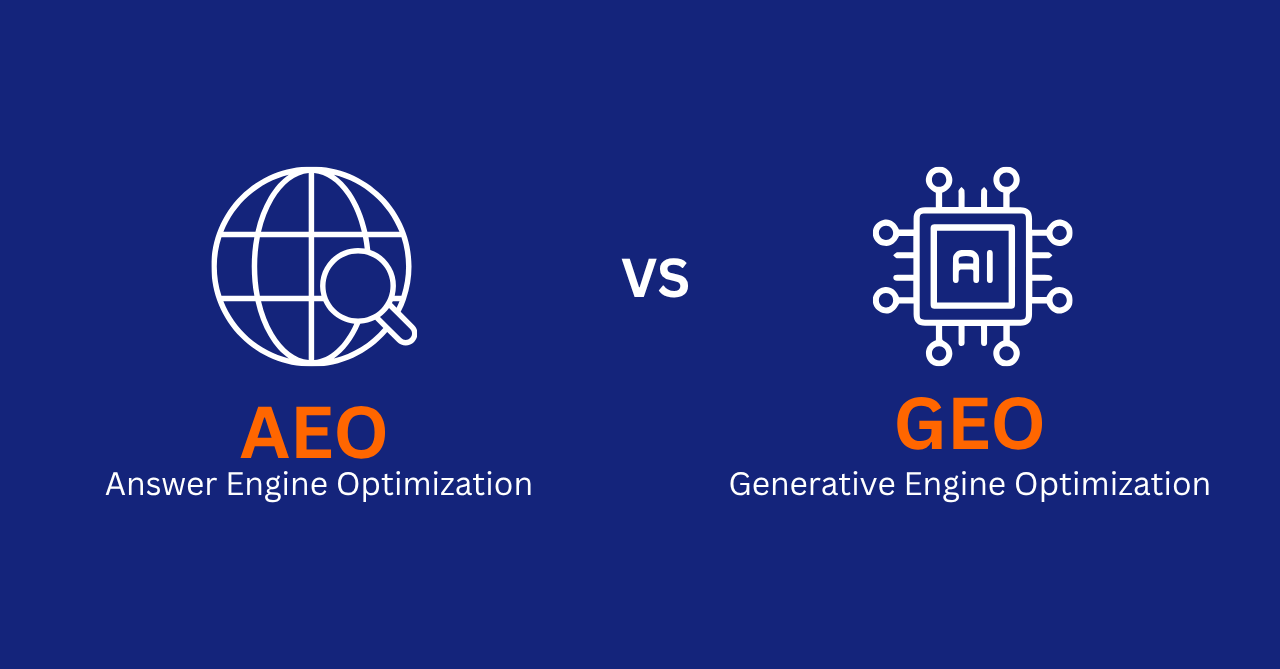
Learn how AEO and GEO are transforming search with AI, voice, and smarter content strategies for better visibility and future-ready SEO growth.
Digital marketing continues to evolve at a rapid pace.
Relying solely on traditional SEO is no longer sufficient to remain
competitive. With the growing influence of voice assistants, AI chatbots, and
generative search engines, optimization strategies now extend to AEO (Answer
Engine Optimization) and GEO (Generative Engine Optimization).
This article explores the concepts of AEO and GEO, their
impact, and effective implementation strategies for modern websites.
What is AEO (Answer Engine Optimization)?
Answer Engine Optimization (AEO) is the practice of
structuring content to deliver direct, concise answers to user queries,
particularly for voice search and featured snippets.
AEO focuses on ensuring that content is selected by search
engines and voice assistants when users ask specific questions.
Key Features of AEO:
- Emphasis on question-based queries
- Content formatted as FAQs, lists, and snippets
- Use of structured data (schema markup)
- Short, clear, and precise answers
Example:
For a query such as “What is digital marketing?”,
AEO-optimized content would:
- Present a clear definition at the beginning
- Use bullet points for readability
- Include schema markup for better indexing
What is GEO (Generative Engine Optimization)?
Generative Engine Optimization (GEO) involves optimizing
content so it can be effectively interpreted, selected, and presented by
AI-powered systems such as chatbots and generative search engines.
Unlike traditional SEO, which focuses on rankings in search
engine results pages (SERPs), GEO emphasizes making content suitable for
AI-generated responses.
Key Features of GEO:
- Focus on context-rich, high-quality content
- Clear and structured formatting
- Strong emphasis on expertise, authority, and trustworthiness (E-E-A-T)
- Ability to address broader, conversational queries
Example:
Rather than targeting a keyword like “best smartphones
2026,” GEO-oriented content would address:
- “What are the best smartphones in 2026 and why?”
- “Which phone is best for gaming, photography, and battery life?”
AEO vs GEO: Key Differences
Aspect AEO GEO
Focus Direct answers AI-generated responses
Platform Search engines & voice assistants, AI tools
& generative engines
Content Style Short and precise Detailed and contextual
Goal Featured snippets, AI citations, and summaries
Optimization Structured data Semantic and contextual
relevance
Impact of AEO and GEO on Websites
Implementing AEO and GEO strategies can:
- Increase organic visibility
- Improve featured snippet rankings
- Enhance AI compatibility
- Strengthen brand authority
- Capture zero-click search opportunities
Implementing AEO on a Website
1. Create Question-Based Content
Content should directly address common user queries. Formats
such as:
- What is AEO in digital marketing?
- How to implement AEO on a website?
- Why is AEO important for SEO?
align well with natural search behaviour.
2. Optimize for Featured Snippets
Search engines prioritize concise and structured answers.
Providing explanations within 40–60 words increases the likelihood of being
featured. Lists and tables improve clarity and extraction.
3. Add FAQ Sections
FAQ sections allow multiple related queries to be addressed
in one place, improving visibility in features like “People Also Ask.”
4. Use Schema Markup
Implementing structured data, such as:
- FAQ Schema
- How-To Schema
- Article Schema
It helps search engines better understand content.
5. Improve Page Structure
A well-organized page enhances readability and indexing:
- Use proper headings (H1, H2, H3)
- Keep paragraphs concise
- Highlight key information
6. Optimize for Voice Search
Voice queries tend to be conversational and longer. Natural
language and long-tail keywords improve alignment with such searches.
Implementing GEO on a Website
1. Create In-Depth Content
Long-form, comprehensive content (typically 1500–2500+
words) allows topics to be covered thoroughly, increasing the chances of AI
referencing the material.
2. Focus on Topic Authority
Building content clusters around related subjects
establishes expertise and strengthens topical authority.
3. Use Natural Language and Context
Content should reflect natural communication patterns, avoid
keyword stuffing, and emphasize intent and meaning.
4. Add Data, Examples, and Insights
Including:
- Real-world examples
- Statistics
- Actionable insights
enhances credibility and usefulness.
5. Strengthen E-E-A-T
Trust signals can be improved through:
- Author profiles
- Case studies
- References to credible sources
6. Optimize for Semantic Search
Using related terms such as:
- AEO strategies
- AI search optimization
- Voice search SEO
- Generative AI SEO
helps improve contextual understanding.
7. Make Content AI-Readable
Clear structure improves AI interpretation:
- Defined headings
- Logical sections
- Simple explanations
Best Practices for Combining AEO and GEO
An integrated strategy maximizes visibility across both
traditional and AI-driven platforms. Effective practices include:
- Combining concise answers with detailed explanations
- Embedding FAQ sections within long-form content
- Prioritizing user intent over keyword density
- Regularly updating content
- Ensuring readability for both users and AI systems
The Future of Digital Marketing: AEO + GEO + SEO
The future of search optimization lies in the integration of
three approaches:
- SEO improves search engine rankings
- AEO enables content to serve as direct answers
- GEO positions content as a reliable AI reference
Together, these strategies create a comprehensive and
future-ready digital marketing framework.
AEO and GEO have become essential components of modern digital marketing. They redefine how content is structured, discovered, and consumed. AEO focuses on delivering immediate answers, while GEO ensures inclusion in AI-generated responses. When applied together, these approaches enhance visibility, build authority, and prepare websites for the evolving landscape of search.






 WhatsApp
 LinkedIn
 Facebook
 X
X
 Email
Email